
MARKET FALLS FEEL PERMANENT. HISTORY SAYS THEY AREN’T
Over the past few weeks, the conversations have started to sound familiar. “Should I stop my SIP?” “Should I move everything to fixed deposits?” “What if this fall continues?” These are not unusual questions. In fact, they show up in almost every market correction. Because when markets fall, it rarely feels temporary. It feels like something has broken. But that feeling, more often than not, is misleading.
WHAT IS MAKING THIS PHASE UNCOMFORTABLE
This time, the uncertainty is being driven by geopolitical tensions. While the conflict itself may not be directly linked to India, the second order impact certainly is. Crude oil prices have risen. Inflation risks are back in focus. Currency and liquidity dynamics are shifting. And even if the situation stabilises, the economic effects do not reverse immediately. Supply chains take time to normalise. Production takes time to restart. Prices take time to adjust. So the discomfort investors are feeling right now is valid. But it is not new.
WHAT HISTORY TELLS US
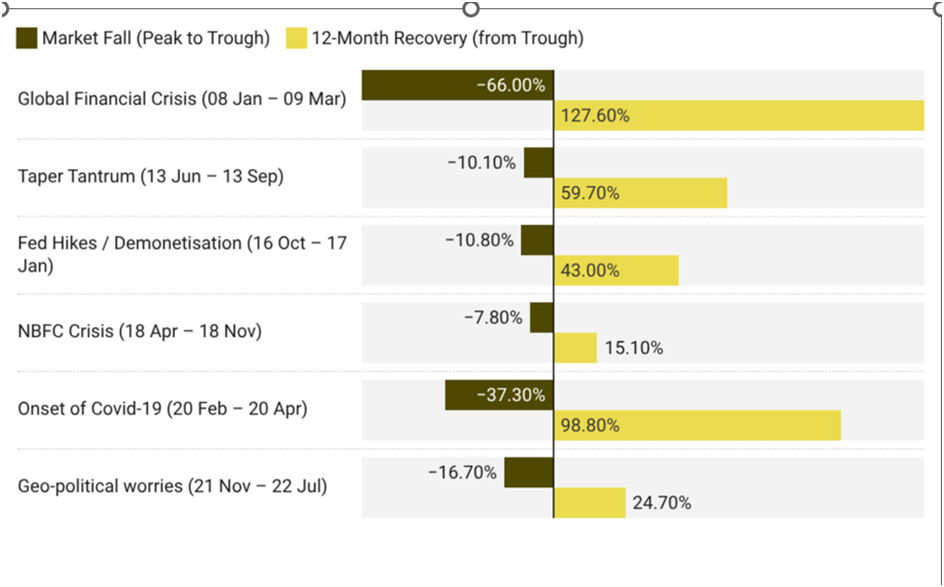
If you step back and look at past market phases, a clear pattern emerges. During the Global Financial Crisis, markets corrected sharply. During Covid-19, the fall was sudden and steep. During events like the taper tantrum or the NBFC crisis, sentiment weakened significantly.Yet in each of these phases, markets recovered. And often, they recovered faster than most investors expected. In several instances, the BSE 500 delivered strong returns within the 12 months following the bottom. The important part is this: Markets do not wait for certainty. They do not wait for wars to end, inflation to fall, or headlines to turn positive. They begin to recover when uncertainty is still high. Which means by the time things start to feel comfortable again, a meaningful part of the recovery has already happened.
THE REAL RISK RIGHT NOW
In phases like this, the biggest risk is not the market fall itself. It is the reaction to it. Stopping SIPs. Redeeming investments after a decline. Moving everything to “safe” assets at the wrong time. These decisions feel like protection in the moment. But in reality, they lock in losses and reduce participation in the eventual recovery.
WHAT SHOULD INVESTORS DO INSTEAD
For long-term investors, the approach remains unchanged. Continue SIPs. Stay aligned to your asset allocation. Avoid reacting to short-term movements. Volatility, while uncomfortable, allows you to accumulate more units at lower levels. This is where SIPs actually do their best work. For those considering lump sum investments or “buying the dip”, it is important to remember that timing the market consistently is extremely difficult. Any additional deployment should be aligned to your allocation and done in a staggered manner. For investors closer to their goals or nearing retirement, the focus should shift towards stability and capital protection, rather than aggressive changes. Different situations require different actions. But reacting emotionally rarely helps any of them.
WHAT ACTUALLY MATTERS NOW
This is not a phase where prediction adds value. No one can say with certainty how the situation will evolve, how long the volatility will last, or when exactly markets will turn. What does matter is discipline. Staying invested. Following a structured approach. Managing behaviour when it matters the most.
CLOSING THOUGHT
Market falls always feel deeper when you are in them. But history has consistently shown that they are temporary. Volatility creates fear in the moment. But patience is what captures the recovery. And more often than not, the difference between a good outcome and a poor one is not the market itself. It is how we respond to it.
Prasad Iyer
[Certified Financial Planner – CFP CM]